More information and pictures on the way
| The Auvergne is.....
One of France's hidden treasures, a region of hills and mountains, valleys, forests and rivers.
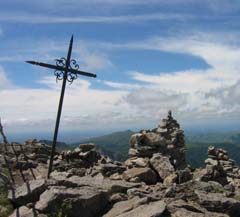
The mountains of Auvergne, which culminate in rocky peaks at over 7000 feet, are the backbone of France's Massif Central. This area of highland is the largest volcanic area in Europe. As the experts stress, the volcanoes are dormant... though not extinct. There is plenty of volcanic activity going on deep below the ground, as is still seen by the hot springs at Chaudes Aigues in the Cantal, where the water comes out of the ground at a temperature of 82°C, the hottest springs in Europe. Nonetheless, there is little reason for alarm, as there has been no volcanic activity in Auvergne for over 3000 years. Traces of the volcanic past are however to be seen throughout the region, not just in the form of the volcanoes themselves, but in the numerous lava flows, volcanic plugs - often capped with castles - and sets of "organ rocks" that form one of the region's remarkable geological features.
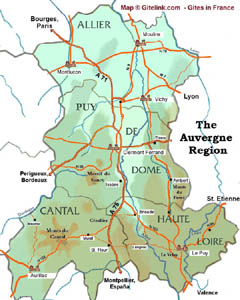
While the northern end of the province stretches up the Loire and Allier valleys towards the low-lying Centre of France, most of the southern part of the region is hilly or mountainous, with large stretches of land lying at over 1000 metres (over 3000 ft). These uplands are penetrated by the valleys of many rivers, most notably the Loire and the Allier which both rise in the south of the Auvergne.
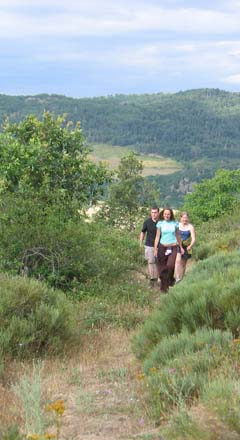
Sparsely populated, the Auvergne boasts a fine natural and cultural heritage, including beautiful valleys, large expanses of coniferous forests, and spectacular hillscapes. It is a region much appreciated by ramblers and nature lovers, as well as by people in search of a holiday far from the madding crowd.
It is a region rich in history too, with a fine collection of historic dungeons and castles, as well as some of the finest romanesque churches in France, many with frescoes. The small city of Le Puy, famous for its lace-making, is one of the most unusual cities in France, due to the rocky pinnacles that stick up in the middle of it.
Of course there are modern attractions too, including a safari park, the Vulcania theme park (illustrating the story of Auvergne's extinct volcanoes, and including 3-D cinema and IMAX), scenic railway lines, cable cars to the peaks of the highest mountains, kayaking and rafting facilities, mountain bike tracks, and much more.
Clermont Ferrand, Auvergne's capital city, is a university city of some 200,000 inhabitants, and the home of the Michelin Tyre Company. It is a busy shopping centre, with plenty of cultural life, and has direct air services to many destinations in France and a few beyond, though currently no direct flights from the UK.
By road, destinations in the Auvergne are from about 7 to 9 hours' drive from Calais or Brussels. The new motorway link between Paris and Spain, via the magnificent new Millau bridge, passes through the heart of the Auvergne.
Three main rivers have their headwaters in the Auvergne: the Loire, the Allier and the Dordogne.
The Auvergne is:
Four departments
The Allier in the north - mostly an area of plains and valleys, with small hills and good agriculture. The Allier is best known cities are Moulins and Vichy, both on the river Allier. Moulins is very much a city of central France, in the style of the towns of the Loire valley. Vichy is a famous spa town with something of an old-fashioned atmosphere. It was the capital of "free" France during the second world war, while the north was under Nazi occupation - a role that it prefers to forget today. It prefers to brand itself as a relaxed place where people still come to take the waters or go to the races.... rather like a small French version of Cheltenham.
The "Puy de Dome" in the middle - largely mountainous, but with a large fertile agricultural plain, the Limagne, in the middle, to the east of Clermont Ferrand. With its tall old houses built of black volcanic stone, Clermont, the home of the Michelin tyre company, is a rather austere city; it lies at the juncture between the fertile agricultural plain called the Limagne, and the Massif Central mountains behind and is dominated by the 1500 metre Puy de Dome, a massive dormant volcano. This is the most famous peak in the "chaine des Volcans", the largest dormant volcanic region in western Europe. South of Clermont lies the Massif du Sancy, a small alpine-looking cluster of mountains slightly higer than the Puy de Dome itself.
The Haute Loire in the south east, the driest and sunniest part of the Auvergne, a lot of it at an altitude of over 800 metres. Virtually the whole department is hilly or mountainous, and a lot is forested. The northern area is centered round the market town of Brioude, with its magnificent romanesque basilica. The southern part of the department is known as "le Velay"; its capital, Le Puy en Velay, was a major pilgrimage centre in the middle ages, a starting point on the route to Santiago de Compostella, and to this day the city's cathedral and St Michael's chapel remain remarkable examples of early mediaeval architecture. Robert Louis Stevenson set off from Le Monastier, just south of Le Puy, in his famous travelogue "Travels with a donkey".
The Cantal, in the south west, the highest of the four departments, a lot of it over 1000m altitude. The department boasts two main centres, the bustling market town of Aurillac, the department's capital, to the west of the high mountains, and Saint Flour, an ancient town perched dramatically at the top of a volcanic outcrop in the east of the department, and visible from the motorway. The centre of the Cantal is dominated by the Plomb du Cantal and the peaks around it, a massive volcanic cluster marking the heart of the Massif Central mountains.
Eight areas:
The Limagne and the plains in the north of the region.
The Monts du Forez in the east of the region, a long chain of uplands broadening out into a high plateau at their southern end.
The Volcanoes, craggy peaks bursting through the uplands between the Puy de Dome beside Clermont Ferrand and the Plomb du Cantal in the south west.
The Cezallier, high prairie land stretching southwards from the Massif du Sancy, famous for its open spaces, cattle grazing and cheeses.
The Haut Allier - where the Allier and its tributaries emerge from the uplands in deep valleys.
The Velay - the high plateau around the town of Le Puy, between the Forez to the north and the Cevennes to the south.
The mountains of the Margeride, dividing the Cantal from the Haute Loire.
The rest of the Cantal uplands, in the south of the department of this name.
Activities:
Hiking and mountain biking almost anywhere in the region
Kayaking and water sports on the Allier and the Loire.
Fishing, coarse and fly, on most of the region's rivers.
Hang gliding from the volcanoes.
Downhill skiing on the Puy de Sancy and the Plomb du Cantal (fully equipped resorts).
Nordic skiing in many places.
|