
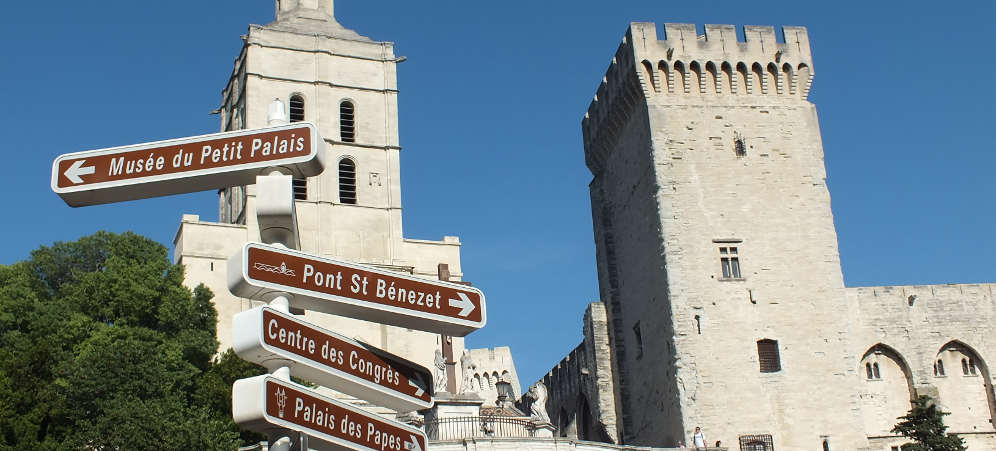
Tourist attractions in Provence
The Gitelink guide to Provence
| Site index: | ||
| An introduction to Provence | Cities, towns and areas | Travel to Provence |
| Provençal food | Main tourist sites | Other regions |
| Provence heritage | Provence climate | Resources |
Provence, France's most popular tourist region
| On this page | Historic Provence | The French Riviera | National parks |
To list everything that there is to see and do in this region would defeat the object of this website, which is to provide tourists and travellers with a selection of ideas to occupy a week or two's holiday in this beautiful region. However, we have selected more than enough ideas for day trips or outings to keep most visitors occupied for far longer than a short holiday.
Culture and heritage
For information on Provence's greatest historic monuments, see the ► Heritage and traditions page.
Places and sites:
1. HISTORIC PROVENCE area
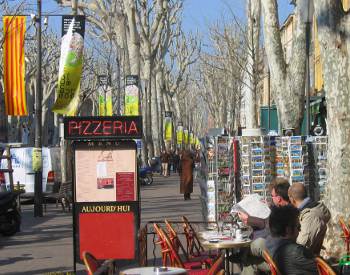 February in Aix :
cafés on
the Cours Mirabeau
February in Aix :
cafés on
the Cours MirabeauArles (13): this small town in the Rhone Delta has classical remains, in particular awell-preserved Roman amphitheatre. as well as the very famous "Saint Trophime" church, and a number of museums. The Vincent Van
Hotels
in Provence
►A choice of
hotels in Avignon
► A choice of
hotels in Aix
en Provence
►A choice of
hotels in Marseilles
Avignon (84) The old city is clustered within impressive mediaeval walls. The most important monuments are the ► Palace of the Popes and the Calvet Museum. There is also the famous "Pont d'Avignon", the remnants of a medieval bridge across the Rhône. Across the river, the ruins of the castle of Villeneuve d'Avignon are worth a visit. The centre of Avignon is a UNESCO world heritage site.
Les Baux de Provence (13) The remains of what was once a town of 4000 inhabitants, built on the Alpille hills at the edge of the Rhone plain. A lot of the buildings have been renovated since the 1970s.
Briançon; (05) capital of the Hautes Alpes department; at an altitude of 1350 metres (over 4000 ft) this is the second highest town in Europe, after Davos. The high town is encircled by ramparts built by Vauban. Nearby is Les Ecrins national park
The ► Camargue (13) A major wetland and nature reserve in the Rhone Delta; it is famous for its white horses, water birds including pink flamingoes, and for bulls that are bred there
Cassis (13) This small port is popular with yachtsman; the coastline east of Cassis is famous for the "Calanques", a series of rocky inlets where limestone cliffs come down to the water's edge. The area is popular with ramblers.
Cuges-les-Pins (13): the OK Corral - a western theme park with rides and activities, plus cowboys and indians. Not very Provençal, but something to keep the kids happy.
Fontaine de Vaucluse (84): the dramatic source of the river Sourgue, which emerges as a full river at the foot of a cliff. It is the fifth largest spring in the world.
Gordes (83) Reputedly one of the prettiest villages in France, Gordes is a large Provençal village standing on a rocky outcrop above the Calavon valley. The renaissance castle is worth a visit.
The ► Gorges du Verdon (83 - 04) The deepest and most dramatic gorge in France - one of France's finest natural sites
► Marseille (13) Marseille is the oldest city in France. A large port city, it boasts a number of monuments, including the Abbaye Saint Victor and the Fort Saint Jean, both near the old port. A must at Marseilles is a boat trip to the Chateau d'If, a historic castle / prison built on a small island in the bay.
Mont Ventoux (84): the last outcrop of the pre-Alps, rising to 1909 metres, to the east of the Rhone Valley northeast of Carpentras. A road leads to the summit. For much of the year, the snow-capped summit is visible from Avignon. A climb to the top of Mont Ventoux is often included in the route of the ► Tour de France.
Orange (84) Famous for its ► Roman remains, notably the amphitheatre (used for the annual festival) and the triumphal arch.
Pont du Gard (30) Just outside modern-day Provence, 11 miles west of Avignon, this dramatic Roman aqueduct is listed as a UNESCO world heritage site.
Saint-Rémy de Provence (13) Roman remains (see ► Roman France)
Saintes-Maries-de-la-Mer (13) is a small village on the coast in the Camargue, with a fortified church: it is famous as a pilgrimage spot for Gypsies or Roms, who come here from all over Europe each year in May, for the festival of Saint Sara. See Camargue
Tarascon (13) City on the banks of the Rhone, with a remarkable mediaeval fortress.
2. Attractions in the ALPES MARITIMES / RIVIERA area
►► French Riviera hotel finder:
For the independent traveller: a large choice of hotels, from sea-front palaces in Nice or Cannes, to smaller and more affordable hotels away from the centres, or slightly inland.Select a resort & category
for a full broad choice of hotels and the best discounted online booking rates available from Booking.com. Book now, pay on the day.
| Resorts
(east to west) |
Two- star |
Three- star |
Luxury hotels |
| Menton / Roquebrune | Select | Select | Select |
| Monaco / Monte Carlo | Select | Select | Select |
| Villefranche
Beaulieu / St Jean |
Select | Select | Select |
| Nice | Select | Select | Select |
| Cagnes |
Select | Select | Select |
| Antibes Juan les Pins |
Select | Select | Select |
| Cannes, | Select | Select | Select |
| Fréjus / San Raphael | Select | Select | Select |
| Saint Tropez | Select | Select | Select |
| Hyères / le Lavandou | Select | Select | Select |
Antibes (06): One of the most famous seaside towns of the Riviera, with 17th century ramparts and a mediaeval castle. There are a number of sights of special interest, including notably the Picasso museum (in the castle) and the Archeological Museum, which has vestiges from Antibes classical past. There are also some beautiful gardent to visit, notably the Exflora gardens and the Eilenroc gardens.
Cannes (06): a Riviera city famous for its festivals and business conventions, and particularly for its annual Film Festival
Chemins de Fer de Provence; the only public-service private railway in France, the CFF is a narow-gauge line running 151 km. from Nice (06) to Digne (04); from sea livel at Nice, the line rises to over 1000 metres before dropping back to under 600 metres. The journey, by diesel railcar, goes through spectacular scenery. A steam service is operated on part of the route during summer weekends. See ► Scenic railways in France
Grasse: (06) twenty kilometres inland, Grasse is famous as the centre of the ► French perfume industry; tons of flowers are harvested annually for this industry, including jasmine and lavender.
Juan-les-Pins (06): very popular and attractive Riviera resort, fashionable with the jet set, film stars and tourists in general.
Menton, (06) an old coastal town almost on the Italian border, is famous for its warm climate and its gardens.
► Nice (06) The capital of the riviera, Nice was made popular almost 200 years ago by the English, and the seafront is known as the Promenade des Anglais. The town has plenty to offer including a Matisse museum, a Chagall museum, the famous flower market, the old town, and the gardens of the castle.
Saint Jean Cap-Ferrat.(06) One of the most exclusive places to live, this is a small peninsula just east of Nice. The peninsula has some fine sandy beaches and a coastal walk. The Villa Ephrussi de Rothschild is a beautiful Italianate villa set among sepctacular gardens overlooking the sea.
Saint Paul de Vence (06) : small mediaeval walled town in the hills just inland from Nice. Popular with artists and musicians, it is home to the Maeght Foundation, a remarkable private museum and collection of modern art.
Saint Tropez (83) : very chic resort, popular with film stars and TV personalities.
Parks
The Parc National du Mercantour ( ► website) is a high alpine park, culminating at the Cime du Gélas - 3143 metres - on the Italian border. Popular with hikers and mountaineers.
The Parc national des Ecrins is partly in Provence, is another high alpine national park.
For more details and other parks, see ► Provence's natural heritage .
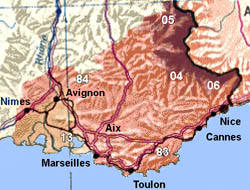
Provence region, covering the French Riviera, the Provence Alps, historic Provence and the area historically linked to Provence
A Gitelink
guide
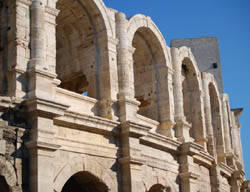
Roman Provence - the Arles arena.
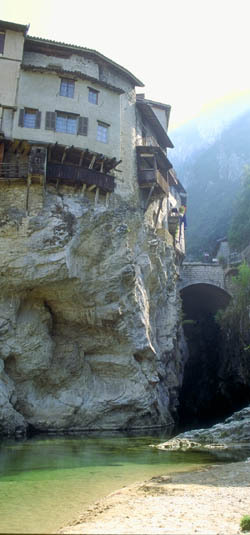
Upper Provence
 A Gitelink
guide
A Gitelink
guide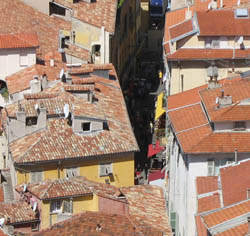
Provençal roofs
Copyright :
Website and text © Gitelink.com renewed 2026
.