

The weather and climate in Provence
The Gitelink guide to Provence
| Site index: | ||
| An introduction to Provence | Cities, towns and areas | Travel to Provence |
| Provençal food | Main tourist sites | Other regions |
| Provence heritage | Provence climate | Resources |
Climate and weather in Provence and the French Riviera
The climate of Provence
It is often said that the climate of Provence is "typically Mediterranean". But this is to oversimplify the complexity of a climate that is very particular, and marked by two distinct parameters: firstly its position with regard to the Alps and to the Mediterranean; secondly the influence of the Rhone valley.

The classic image of Provence weather - blue skies warm days
In the Alpes Maritimes department, at the eastern end of the French Riviera , where high mountains come right down to the coast, the climate on the coastal strip (in places just a few hundred yards wide!) is particularly mild, and the town of Menton, on the Italian border, has the mildest winters of any place in France. In this part of France, where frosts are virtually unheard of, plants such as bougainvillia and aloe vera can grow profusely in sheltered outdoor locations.
Yet the most significant aspect of the climate of this part of France is its dryness. Compared to other parts of France at similar altitudes or latitudes, this south-eastern corner of France has far less rainfall. The southern end of the Alps have less rainfall than areas further north or east.
Hotels
in Provence
►A choice of
hotels in Avignon
► A choice of
hotels in Aix
en Provence
►A choice of
hotels in Marseilles
The lines of tall cypress trees, emblems of Provence and notably the lower Rhone valley, are there for a purpose - to protect growing plants from the force of the cold (or sometimes in summer, hot) Mistral wind.
The Provençal Alps are the sunniest part of the range, and Briançon, at an altitude of 1350 metres, is reputed to be one of the sunniest towns in France, with over 300 days of sunshine per year.
 A Gitelink
guide
A Gitelink
guideTemperature tables:
| Location | Average daily max Jan. | Average daily max Aug. | Average daily max Nov. |
| Avignon | 9° | 28° | 13.5 |
| Marseille | 10.8 | 28.8 | 14.9 |
| Nice | 13° | 28° | 16° |
| For comparison | |||
| (London) | 6° | 22° | 10° |
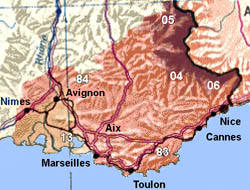
Provence region, covering the French Riviera, the Provence Alps, historic Provence and the area historically linked to Provence
A Gitelink
guide

Provençal sunset, at the end of a warm summer's day.

Bougainvillia growing on a house by the sea near Nice.
Copyright :
Website and text © Gitelink.com renewed 2021
.