
Northern Spain, España verde
The
Basque Country, Cantabria, Asturias, Galicia
Ac commodation in "España verde" - Coastal regions of Northern Spain
Holiday
cottages, traditional casas rurales and villas
~ les
gîtes et locations
Best
rates,
no extra
fees ! Gitelink works either directly
with owners, or else only
with booking sites that do not charge the customer extra booking fees,
administrative charges or credit card fees. Gitelink
takes no commission on reservations made directly with owners, but may
receive a small compensation on bookings made through an online
booking portal..
Click
on any link below for a detailed description of the property, with
photos and prices
Cliquez sur un des liens ci-dessous pour un descriptif détaillé du gite, avec photos et tarifs
Cliquez sur un des liens ci-dessous pour un descriptif détaillé du gite, avec photos et tarifs
- Seaside gite near Santiago. Gite for up to 6 people on the water's edge in small Galician village. Beach right next to the house. Good snorkelling; Family friendly property. Free wifi and telescope. Au sud-ouest de Saint-Jaques de Compostelle, gite pour 6, au bord de l'eau dans un village galiciane. Accès direct à la plage. Equipé pour bébéi. Telescope et wifi gratuits.
- Northwest tip of Spain. Rural gites with gardens in very quiet location near Ortiguera. Two properties each for up to 4 visitors Beach 8 miles. Spectacular coastal scenery close by. Train station 4 km. Deux gites traditionnels dans au calme vers la pointe nordouest de l'Espagne. Deux gîtes pour jusque'a 4 personnes chacun. Plage 12 km; paysage côtier spectaculaire à proximité.
- Rural gite near Oviedo. Traditional Asturian house in a village between Oviedo and the coast. Three bedrooms. Stone walls, beams, outdoor patio. 20 km from airport. Beaches 15 km. Maison de village asturienne entre Oviedo et la côte. Trois chambres, murs en pierres apparantes, patio extérieur. A 15 km des plages ; accès facile à Aviles, Oviedo ou Gijon.
- In the hills south of Santander. Attractive country cottage with gardens, in the hills 25 miles south of Santander. Mountain views. Four bedrooms; sleeps 8. 5 minutes from village with shops & restaurants. Gite rural dans les collines au sud de Santander; jardin, vues sur monts et vallées. Quatre chambres, jusqu'à 8 personnes. A 5 min du village avec magasins et restaurants
- Near Basque coast. Three-bedroom apartment in country house in the hills 3 km from the sea and 20 km from Bilbao . Typical Basque house. Large garden, billiards, balcony, barbecue, free wifi. Supermarket 3.5 km. Appartement 3 chambres dans maison de campagne basque typique dans les collines à 3 km de la côte et à 20 km de Bilbao. Grtand jardin, billard, balcon, barbecue, wifi gratuit. Supermarché à 3,5 km..
- Cottage
in Galicia


 Tranquility, nature and comfort at Casa de
Flores in rural Galicia. Stepping out of the door is stepping back in
time. Sleep up to 3, 70m2 living plus garden and fields. Calme, nature et confort
à Casa
de Flores en Galice rural, où le temps s'est
arrêté. Gite de 70m² pour
3 avec jardin et prés.
Tranquility, nature and comfort at Casa de
Flores in rural Galicia. Stepping out of the door is stepping back in
time. Sleep up to 3, 70m2 living plus garden and fields. Calme, nature et confort
à Casa
de Flores en Galice rural, où le temps s'est
arrêté. Gite de 70m² pour
3 avec jardin et prés. - For the largest selection of rural properties, view the Gitelink Andalucia rural rentals page
Access to
Northern Spain:
A choice of flights by traditional and low-cost airlines to regional airports in Santander, Santiago, Oviedo (Asturias), A Coruña, Leon and Porto (Portugal) Ferries from the UK to Santander or Bilbao. Overnight trains via Paris & Hendaye.... change at the botrder.
A choice of flights by traditional and low-cost airlines to regional airports in Santander, Santiago, Oviedo (Asturias), A Coruña, Leon and Porto (Portugal) Ferries from the UK to Santander or Bilbao. Overnight trains via Paris & Hendaye.... change at the botrder.
| Owners -
add your
website to Gitelink España: Announce your property on Gitelink Spain. List your property directly or through your page on one of the online booking sites partnered with Gitelink.com. Gitelink is a selective directory, listing only attractive traditional or traditional-style holiday rental accommodation. To submit your property for approval, click here.l |
|
Añadir
su sitio web :
El directorio Annuaire Gitelink España permite a los propietarios de cortijos rurales, haciendas y fincas con caracter individual promover sus viviendas directamente sin intermediario en los mercados inglés y francés. Es esencial tener un sitio web con informacion en inglés o en francés. Haz clic aquí |
Copyright Gitelink.com 2007-2024
► Return to Gitelink España ► Go to Gitelink France
The
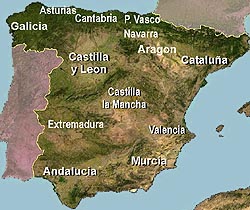
regions of Spain
Traditional gites and holiday rentals in Spain
Best rates on holiday rentals in Spain - No extra fees.What you see is what you pay.
In some parts of Spain, all visitors must pay a daily tourist tax. This is never included in accommodation rates quoted, and must be paid to the host.
With Gitelink España, book directly with owners, or through booking sites that do not add extra booking fees, administrative charges or credit-card charges. Click the links for full details and photos or each gite listed listed
Key to listings:
Website in English
Site
en français
Website auf deutsch  Website in Nederlands
Click on any link for a detailed description of the property, with photos and prices
Gitelink
España - Green
Spain
Le nord de l'Espagne:
cliquez ici.
The
northern coast of Spain has only recently begun to attract visitors
from outside Spain. Until recently, a poor road network and a lack of
direct access by air meant that it was a long and arduous journey to
reach anywhere along the northern coast of Spain, beyond the Basque
region which is traversed by main roads to Madrid. In recent years, all
that has changed - and while the coastal motorway does not cover the
whole distance of this long coastline, the region is now accessible.
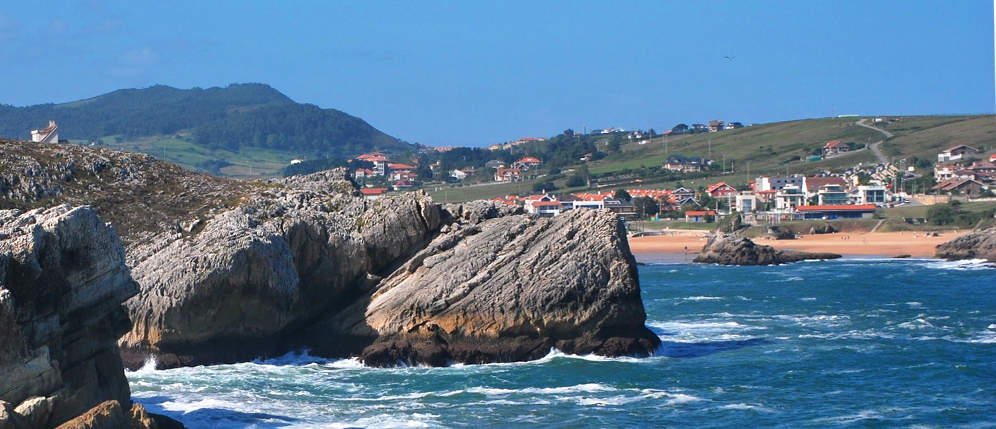
Even today, the large majority of holidaymakers in this region are Spanish - but visitors from other countries are moving in. It is easy to understand why; unlike the Mediterranean coast, this part of Spain has not been defaced by large-scale property speculation - though here and there it is now happening. Besides, this region is very different from the Mediterranean coast. This is Atlantic Spain, not Mediterranean Spain, and it is often called "España Verde", or Green Spain, on account of its temperate climate, which includes rain. Hence the coastline is very different - cliffs and coves, tides and waves, small towns and a few big ports.
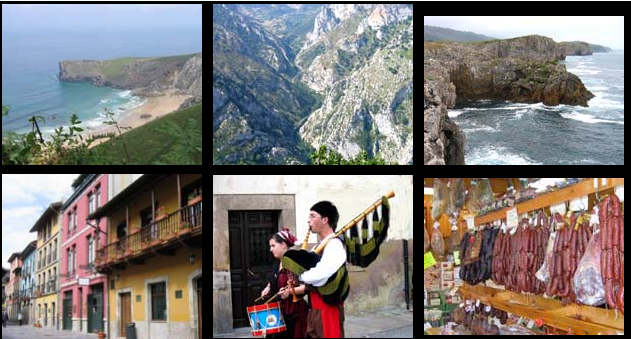
For most of its length, the coastline is hilly or even mountainous, and the Picos de Europa, with magnificent peaks, deep valleys, and even ski slopes, begin just a few kilometres inland. Asturias and Galicia, like Brittany or Wales or Ireland, belong to Europe's Celtic fringe and share certain cultural traditions such as bagpipes.
Culturally, the region has much to offer, from the very old - historic cave paintings and Visigothic churches - to the very new, such as the Guggenheim museum in Bilbao.
A guide to the regions of Spain
La
côte nord de
l'Espagne
n'a commencé que depuis peu à attirer des touristes de
l'étranger. Il y a peu de temps encore, la plupart de la
région
était difficilement accessible à cause d'infrastructures
inadéquates; mais tout cela a
changé, et même si l'autoroute côtière n'est
pas encore
complétée, toute la région est désormais
accessible.
Toutefois encore aujourd'hui la plupart des touristes ici sont espagnols, et on comprend pourquoi ils viennent. A la différence de la côte méditerranéenne, la côte nord a été peu défigurée par la spéculation immobilière, et même si cela commence par endroits, la plupart de cette côte reste épargnée. D'ailleurs, c'est une côte très différente de la côte du sud; ici c'est l'Espagne atlantique, appellée communément "Espagne verte", à cause de son climat tempéré et ses pluies. La côte ici ressemble un peu à la Bretagne, avec des montagnes en plus.
Entre Cantabrie et les Asturies, les Picos de Europa, se dressant à quelques kilomètres seulement de la côte, sont un massif montagneux impressionnant, avec de hautes cimes et de profondes vallées, et même des stations de ski.
Les Asturies et la Galice font partie de la frange céltique de l'Europe, et partagent avec d'autres régions celtiques comme la Bretagne ou l'Irlande des traditions communes, comme par exemple les cornemuses.
la région est riche en culture, allant de la préhistoire avec les peintures d'Altamira, au tout moderne avec le musée Guggenheim de Bilbao.
Click here for more accommodation in Spain
including
the areas of
Santiago
de Compostella, Oviedo, Aviles, Santander, Bilbao, San
Sebastian
Gitelink Espagne côte nord,
l'Annuaire des locations rurales de la Galice au Pays Basque
Gitelink Espagne côte nord,
l'Annuaire des locations rurales de la Galice au Pays Basque
Le nord de l'Espagne:
cliquez ici."Green
Spain" - the north of Spain
The
northern coast of Spain has only recently begun to attract visitors
from outside Spain. Until recently, a poor road network and a lack of
direct access by air meant that it was a long and arduous journey to
reach anywhere along the northern coast of Spain, beyond the Basque
region which is traversed by main roads to Madrid. In recent years, all
that has changed - and while the coastal motorway does not cover the
whole distance of this long coastline, the region is now accessible.Even today, the large majority of holidaymakers in this region are Spanish - but visitors from other countries are moving in. It is easy to understand why; unlike the Mediterranean coast, this part of Spain has not been defaced by large-scale property speculation - though here and there it is now happening. Besides, this region is very different from the Mediterranean coast. This is Atlantic Spain, not Mediterranean Spain, and it is often called "España Verde", or Green Spain, on account of its temperate climate, which includes rain. Hence the coastline is very different - cliffs and coves, tides and waves, small towns and a few big ports.
For most of its length, the coastline is hilly or even mountainous, and the Picos de Europa, with magnificent peaks, deep valleys, and even ski slopes, begin just a few kilometres inland. Asturias and Galicia, like Brittany or Wales or Ireland, belong to Europe's Celtic fringe and share certain cultural traditions such as bagpipes.
Culturally, the region has much to offer, from the very old - historic cave paintings and Visigothic churches - to the very new, such as the Guggenheim museum in Bilbao.
A guide to the regions of Spain
 L'Espagne
verte - le nord de l'Espagne
L'Espagne
verte - le nord de l'Espagne
La
côte nord de
l'Espagne
n'a commencé que depuis peu à attirer des touristes de
l'étranger. Il y a peu de temps encore, la plupart de la
région
était difficilement accessible à cause d'infrastructures
inadéquates; mais tout cela a
changé, et même si l'autoroute côtière n'est
pas encore
complétée, toute la région est désormais
accessible.Toutefois encore aujourd'hui la plupart des touristes ici sont espagnols, et on comprend pourquoi ils viennent. A la différence de la côte méditerranéenne, la côte nord a été peu défigurée par la spéculation immobilière, et même si cela commence par endroits, la plupart de cette côte reste épargnée. D'ailleurs, c'est une côte très différente de la côte du sud; ici c'est l'Espagne atlantique, appellée communément "Espagne verte", à cause de son climat tempéré et ses pluies. La côte ici ressemble un peu à la Bretagne, avec des montagnes en plus.
Entre Cantabrie et les Asturies, les Picos de Europa, se dressant à quelques kilomètres seulement de la côte, sont un massif montagneux impressionnant, avec de hautes cimes et de profondes vallées, et même des stations de ski.
Les Asturies et la Galice font partie de la frange céltique de l'Europe, et partagent avec d'autres régions celtiques comme la Bretagne ou l'Irlande des traditions communes, comme par exemple les cornemuses.
la région est riche en culture, allant de la préhistoire avec les peintures d'Altamira, au tout moderne avec le musée Guggenheim de Bilbao.
Click here for more accommodation in Spain