
What are gites? And how best to book one?
The terminology of holiday rentals in France
What is a gite? Is it different from a cottage or a villa ?
The short answer is "no" - at least not in the way that it is commonly used (or abused) on the Internet. But even so the term does tend to be used more specifically to define a particular type of holiday rental accommodation, to the exclusion of other types.For some holiday properties, the expressions gite, cottage, holiday rental, holiday cottage, holiday let, and vacation rental, and even bnb or chalet, may all be quite appropriate, and frequently used. But within this disconcerting array of alternatives, each term has certain nuances of meaning - or should have. The problem is that owners and agencies often use words with a nonchalent disregard for their real meaning, and sometimes choose a deliberately more flattering term to describe a rental property that is really not much to write home about.
FAQ: Understanding the term "Gite" and related holiday rental types
Find gites in France:
Traditional gites and BnBs direct from owners - no added commission, no hidden extras.
Click on any area on the map to show area listings
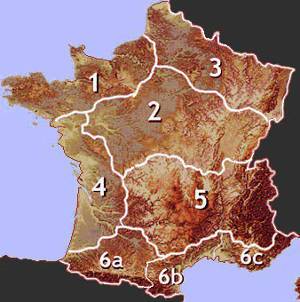
Alternatively check out gites and b&bs by location using the interactive area maps
What does the word "gite" actually mean?
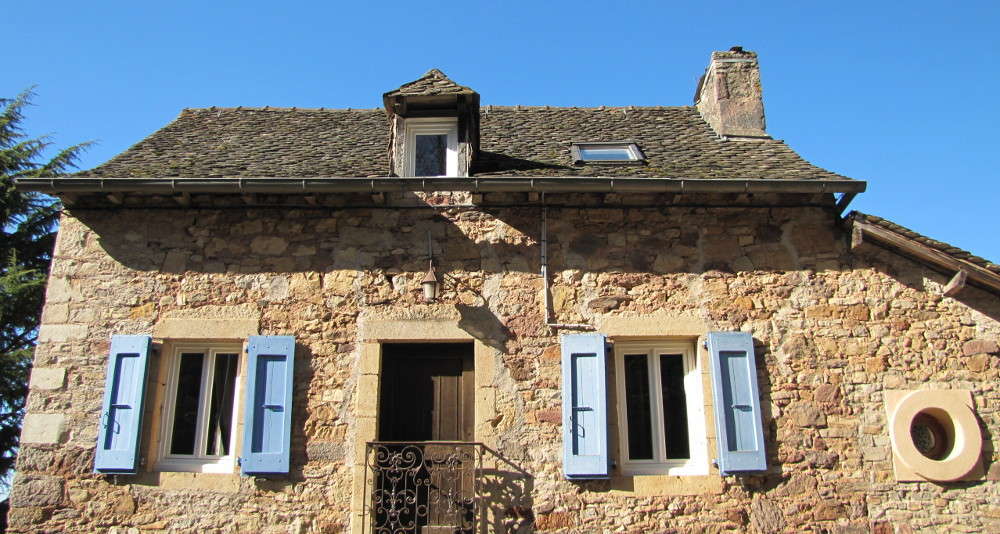
A gite is a rural holiday rental, typically a restored country cottage,
barn, or farmhouse. While originally a simple place to stay, most
modern gites
now offer comfortable or even luxury accommodation.
Is a gite different from a cottage, villa, or
holiday rental?
Generally no. These words all describe types of holiday accommodation,
though each has its own nuance. A property may be called a gite,
cottage, villa, or holiday rental depending on style and context.
What is the difference between a gite and a
cottage?
A cottage usually refers to a traditional rural dwelling. It is often
the closest English equivalent to a “gite”.
What is a villa?
The word villa
is used to describe a detached house – modern or classic – and refers
to
the building style rather than its holiday rental function.
What is a chalet?
Traditionally a wooden mountain building, though the term today can
include modern wooden homes or prefabricated holiday bungalows.
What is a holiday rental or holiday let?
A broad term covering any furnished property rented to tourists,
including gites, cottages, villas, chalets, apartments, bungalows, and
mobile homes.
What is a holiday apartment or vacation rental?
Widely used on international booking sites, sometimes loosely applied
to a range of property types from apartments to detached villas.
What is a BnB?
The term BnB, or un
Airbnb, is used in French to refer to any kind
of short-stay rental, whether B&B (most probably not... no
breakfast provided) , or non-catered holiday accommodation in a private
dwelling
Detailed Explanations & Background
In correct usage, the various terms that describe holiday rental properties can be defined as follows:
-
Gite:Definition: a gite is most commonly a rural holiday rental, frequently a renovated country cottage or barn conversion in a village or the countryside. The word “gite” primarily defines the function of the property, and some modern buildings are also marketed as gites.
Historically, gites offered basic accommodation, and this is still true for some, such as one-ear-of-wheat (“un épi”) listings with Gites de France. But today the concept spans mid-range to luxury holiday rentals, especially those advertised internationally. Using the Gitelink directory, visitors can clearly see each property’s qualities thanks to their individual websites and photos.
In France, the term also describes other accommodation types:
• A "gîte d'étape" – simple overnight lodging on long-distance hiking or cycling routes.
• A "gîte équestre" – similar lodging for riders on horseback treks.
In Spain, equivalent rural rentals are called "finca", "cortijo" or simply "casas rurales". -
Villa:A villa describes a modern detached property or classic residence and refers to the nature of the building rather than its function. A suburban house near Nice may call itself a villa, and still be hired out as a gite.
-
Holiday cottage:Evokes a small traditional rural home once occupied by a farm worker or smallholder. Because of its homely, rustic connotations, the term “cottage” is used widely – often as the best English translation of “gite”.
-
Chalet:Traditionally a wooden mountain dwelling, or stone-and-wood alpine building. Now also used for modern wooden houses or small prefabricated holiday homes. The Gitelink directory features authentic chalets, but not the prefabricated types.
-
Holiday rental, holiday let:(French: "location de vacances") These broad terms include seaside apartments, bungalows, fixed mobile homes in holiday parks, and almost any type of furnished tourist accommodation.
-
Holiday apartment, vacation rental, holiday lodging:Largely American English terms, widely adopted on international websites. Their usage is often arbitrary: some sites describe detached villas as “holiday apartments” and vice versa.
► Find gites or B&Bs now: Gites in France B&Bs in France Gites in Spain
The Gitelink selectionHow to book a gite
There are any number of different ways to book a gite: but take care ! If you use a big online rentals site, warning : you may well end up paying far more for your gite or cottage holiday than you need to. And if you don't pay more than you need to (and even if you do) the chances are that the booking site is taking a good slice of the booking fee. Many gite owners, like the owners of many small hotels, b&bs and campsites, struggle hard to make ends meet, and the commissions taken by online rentals sites make the struggle even harder.Depending on the rental agency or booking site used, visitors can be charged a fee of up to 16% on top of the rental charge – not to mention the commissions charged to property owners.
For example, you discover a delightful holiday cottage, with accommodation for 4 people, for which the weekly rental charge announced on the rental site is a reasonable 790 € for a week. So you go through the booking process, and by the time you reach the checkout, the cost has jumped up to 900 €.
What a waste, if you could have booked the cottage at the stated rental price, by contacting the owners directly.
Book
directly
with
owners !
Best
rates, no risk, no hassle!
Start your search by clicking on the map above
Most properties listed on Gitelink can be booked
directly
with owners,
avoiding the commissions and hidden fees
charged by online holiday rental agencies.In addition, direct booking with the owners, or booking through a portal that does not require you to pay them first is by far the best option in the event that you should need to modify or cancel your booking.
The Internet is full of horror tales from people who have been unable to cancel a booking through a reservation site, or who have done so and been charged nonetheless, or have been given a very meagre reimbursement.
Direct booking avoids this: you are in direct contact with the property owner, and most owners take great pains to ensure good customer relations