
A short guide to the Auvergne
The
green heart of southern France
 Auvergne
guide Auvergne
guide |
The
Departments / counties |
Auvergne food and drink |
| Things to see and do in
Auvergne |
The
Auvergne in figures |
Auvergne holiday cottages |
An inside guide to Auvergne
 Auvergne is one of France's
hidden treasures,
a region of hills and mountains, valleys, forests and rivers, a region
where - except for the regional capital, Clermont Ferrand - the hustle
of city life is something unknown, and time seems to move at
a
slower and much more agreeable pace.....
Auvergne is one of France's
hidden treasures,
a region of hills and mountains, valleys, forests and rivers, a region
where - except for the regional capital, Clermont Ferrand - the hustle
of city life is something unknown, and time seems to move at
a
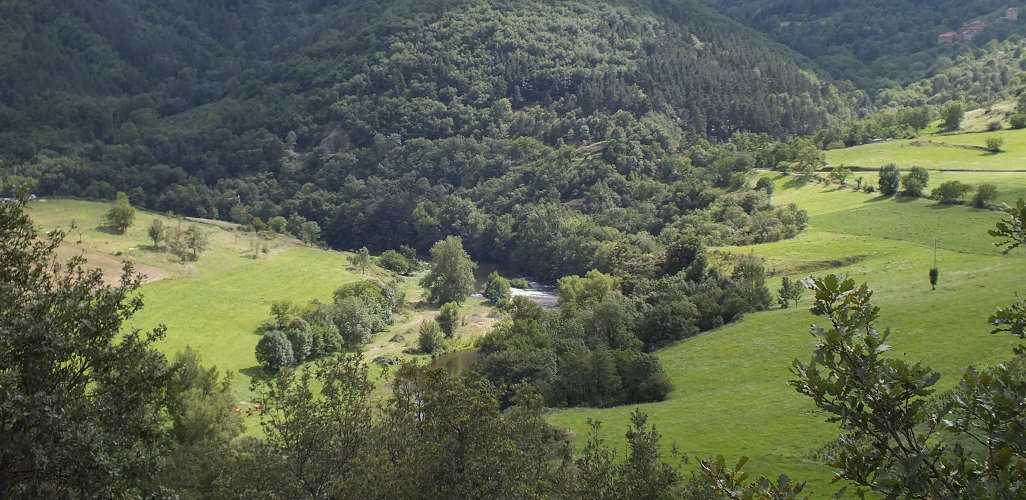
slower and much more agreeable pace..... The mountains of Auvergne, which culminate in rocky peaks at over 1700m / 7000 feet, are the backbone of France's Massif Central. This area of highland is the largest volcanic area in Europe. As the experts stress, the volcanoes are dormant... though not extinct. There is plenty of volcanic activity going on deep below the ground, as is still seen by the hot springs at Chaudes Aigues in the Cantal, where the water comes out of the ground at a temperature of 82°C, the hottest springs in Europe. Nonetheless, there is little reason for alarm, as there has been no volcanic activity in Auvergne for over 7000 years. Traces of the volcanic past are however to be seen throughout the region, not just in the form of the volcanoes themselves, but in the numerous lava flows, volcanic plugs - often capped with castles - and sets of "organ rocks" that form one of the region's remarkable geological features.
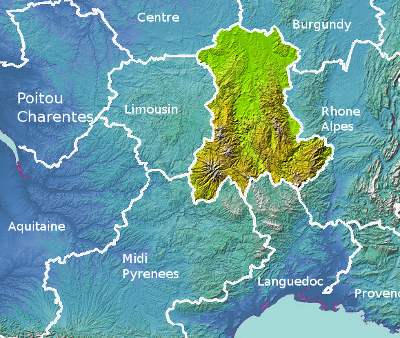
While the northern end of the province stretches up the Loire and Allier valleys towards the low-lying Centre of France, most of the southern part of the region is hilly or mountainous, with large stretches of land lying at over 1000 metres (over 3000 ft). These uplands are penetrated by the valleys of many rivers, most notably the Loire and the Allier which both rise in the south of the Auvergne.
Sparsely populated, the Auvergne boasts a fine natural and cultural heritage, including beautiful valleys, large expanses of coniferous forests, and spectacular hillscapes. It is a region much appreciated by ramblers and nature lovers, as well as by people in search of a holiday far from the madding crowd.
It is a region rich in history too, with a fine collection of historic dungeons and castles, as well as some of the finest romanesque churches in France, many with frescoes. The small city of Le Puy, famous for its lace-making and UNESCO listed cathedral, is one of the most unusual cities in France, due to the rocky pinnacles that stick up in the middle of it.
Other interesting towns to visit in Auvergne include the "art and history" city of Brioude, the French knife-making capital of Thiers, the genteel spa town of Vichy, and the capital of "High Auvergne" Saint Flour, among others
Of course there are modern attractions too, including a safari park, the Vulcania theme park (illustrating the story of Auvergne's extinct volcanoes, and including 3-D cinema and IMAX), scenic railway lines, cable cars to the peaks of the highest mountains, kayaking and rafting facilities, mountain bike tracks, and much more. The Auvergne Wildlife Park at Ardes sur Couze, near Issoire, is also worth a visit.
Three main rivers have their headwaters in the Auvergne: the Loire, the Allier and the Dordogne.
Clermont Ferrand, Auvergne's capital city, is a university city of some 200,000 inhabitants, and the home of the Michelin Tyre Company. It is a busy shopping centre, with plenty of cultural life,
Travel information - Access to Auvergne :
Though the region is not served directly by any year-round low-cost airline services, Auvergne is an accessible area, and just that little bit closer to Britain, Paris or the north of Europe than the southwest of France and the Mediterranean regions, which it borders to the south and west.
 By AIR:
The Clermont Ferrand airport has direct flights with many
destinations in France and a few beyond. Low-cost airline Ryanair fly
to Clermont Ferrand from London Stansted in the summer.
Other nearby airports served by low-cost carriers are Limoges
and
Rodez in the west, and Lyon in the east. By ROAD:
By road, destinations in the Auvergne are from about 7 to 9 hours'
drive from Calais or Brussels, and 4 from Paris. The new motorway link
between Paris and Spain, via the magnificent Millau viaduct,
passes through the heart of the Auvergne (A 71 in the north, A 75 in
the south). The A 89 motorway is an east-west link providing easy
access to the Auvergne from Lyon and Bordeaux.
By RAIL:
Fast Intercités express trains run between Clermont Ferrand
and
Paris, via Vichy and Moulins, in three and a half hours. Clermont
Ferrand
also has direct services to Lyon (just over two and a half hours), and
rather slow but very picturesque direct services to Nimes and to
Beziers.
By AIR:
The Clermont Ferrand airport has direct flights with many
destinations in France and a few beyond. Low-cost airline Ryanair fly
to Clermont Ferrand from London Stansted in the summer.
Other nearby airports served by low-cost carriers are Limoges
and
Rodez in the west, and Lyon in the east. By ROAD:
By road, destinations in the Auvergne are from about 7 to 9 hours'
drive from Calais or Brussels, and 4 from Paris. The new motorway link
between Paris and Spain, via the magnificent Millau viaduct,
passes through the heart of the Auvergne (A 71 in the north, A 75 in
the south). The A 89 motorway is an east-west link providing easy
access to the Auvergne from Lyon and Bordeaux.
By RAIL:
Fast Intercités express trains run between Clermont Ferrand
and
Paris, via Vichy and Moulins, in three and a half hours. Clermont
Ferrand
also has direct services to Lyon (just over two and a half hours), and
rather slow but very picturesque direct services to Nimes and to
Beziers. Le Puy en Velay is best reached from Paris by TGV to Saint Etienne, and local train through the Loire gorges thereafter.
By CYCLE :
The Auvergne is crossed from north to south by French national cycleway V70.
This runs from its junction with the east-west European cycle route EV6
(Danube to the Atlantic) at Cuffy, just south of Nevers (Burgundy), to
the Mediterranean coast south of Montpellier. The Auvergne section of
V70 is due for almost complete opening in 2020; basically it follows
the valley of the river Allier from near its confluence with the Loire
near Nevers, to Pradelles, just north of Langogne, and close to the
river's source. It passes through Moulins, Saint-Pourçain,
Vichy, Vic
le Comte, Auzon, Brioude, Langeac and Monistrol d'Allier. Following the
river Allier almost up to its source, It is the easiest of the
north-south cycle routes to the Mediterranean. South of Pradelles,
cyclists can follow relatively traffic-free routes through Langogne,
then the D906 which slopes gently down from the Col du Thort towards
Villefort and on to the Mediterranean plains. On FOOT :
The Auvergne is one of the major hubs of the French national
long-distance hiking trail network, the sentiers de Grande
Randonnée.
See hiking
trails in France.Click here for details of the Auvergne's four departments , Puy de Dome, Allier, Haute Loire and Cantal
Eight areas of the Auvergne:
The Limagne and the
plains in the north of the region. The Monts du Forez in
the east of the region, a long chain of uplands broadening out into a
high plateau at their southern end. The Volcanoes,
craggy peaks bursting through the uplands between the Puy de Dome
beside Clermont Ferrand and the Plomb du Cantal in the south west. The Cezallier, high
prairie land stretching southwards from the Massif du Sancy, famous for
its open spaces, cattle grazing and cheeses. The Haut
Allier - where
the Allier and its tributaries emerge from the
uplands in deep valleys. The Velay - the high
plateau around the town of Le Puy, between the Forez to the north and
the Cevennes to the south. The
mountains of the Margeride,
dividing
the Cantal from the Haute Loire. The rest
of the Cantal
uplands, in
the south of the department of this name.Activities:
Hiking and mountain biking
almost anywhere in the region
Kayaking and water sports on the Allier and the Loire.
Fishing, coarse and fly, on most of the region's
rivers.
Hang gliding from the volcanoes.
Downhill skiing on the Puy de Sancy and the Plomb du
Cantal (fully equipped resorts).
Nordic skiing in many places.

A Gitelink
guide
Accueil: l'Auvergne en français
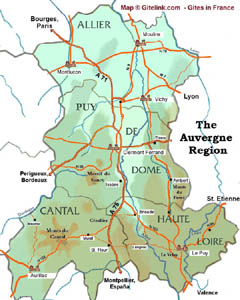
Click to open a large interactive map of the Auvergne
| Useful links |
| Airport - Clermont Ferrand |
| Small campsites in Auvergne |
| Independent hotels in Auvergne |
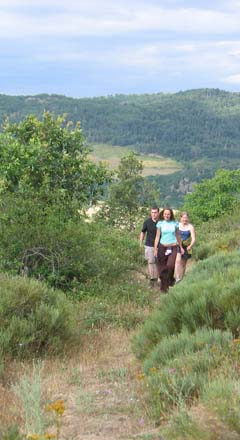
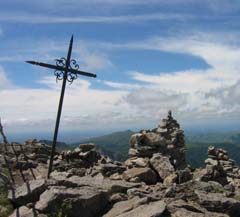
Summit of the Puy Mary - Cantal
All texts
& photos ©
Gitelink.com.
| More regional guides |
| Guide to Provence |
| Guide to Brittany |
| Guide to Languedoc-Roussillon |
| Other regions of France |