
Auvergne regional specialities
Tastes of the Auvergne
The Auvergne is not renowned as one of the most famous regions of France in terms of wining and dining; but like many other regions of the world, it is nonetheless a region with plenty to offer when it comes to regional specialities. The region also produces some very reasonable wines, and is relatively well endowed in good restaurants.....
Auvergne regional specialities:
A profoundly rural and mountainous region, the Auvergne is one of the leading French regions (some indeed claim that it is the leading region) when it comes to cheese. A cheeseboard made up exclusively of Auvergne cheeses can hold its own against a board of cheeses from any other French region, both in terms of variety and of quality.| Cheeses | Wines | Specialities | Restaurants |
The principal cheeses of the Auvergne:
Pressed cheeses:Cantal A very tasty uncooked pressed cheese from the Auvergne mountains, Cantal is a cheese that many consider to be quite close to an English farmhouse cheddar or chester. A lot of this "appellation contrôlée" cheese is made on farms, but local dairies in the region also produce it in large quantities. (Some also produce Cheddar for export to the UK)
Cantal comes most commonly in two varieties: "jeune" (young) and "entre deux" (between two), meaning cheese that has matured for longer. This cheese's strength and taste increase with ageing, and generally speaking cantal cheese is stronger than cheddar.
Two smaller areas within the Cantal department produce specific appellations of their own, Salers and Laguiole. These cheeses - made from the milk of cows grazing at high altitude, tend to be more expensive than generic Cantal, and are generally aged longer. They are unpasturised cheeses made only during the summer, and only from the milk of cows grazing in the high pastures.
Blue cheeses
Bleu d'Auvergne / Auvergne blue ; Possibly the most famous of all French blue cheeses, Bleu d'Auvergne is manufactured through most of upland Auvergne. It is a cheese that can vary considerably in taste and strength, depending on how old it is and how it has matured; but a good Auvergne Blue can be spread on bread like butter.
La Fourme d'Ambert is a mild blue cheese , often with an almost nutty flavour. No-one should find this too strong. It is produced in the sector of Ambert in the Forez mountains of the Puy de Dôme.
Saint Agur : this is a well known brand, not a traditional cheese. Made in the area of Le Puy, it is essentially a fairly creamy Auvergne blue.
Soft cheeses.
Saint Nectaire (AOC) can be one of the greatest of French cheeses - but it is also a cheese that varies considerably in quality and taste. To start with there are two distinct types, the farm variety and the dairy variety. The farm variety is generally better and more expensive, the dairy variety, usually found in supermarkets, is frequently sold too young. When this cheese is young, it is quite dry and hard; a properly matured Saint Nectaire should be soft and elastic, with a slight tendency to flow if left at room temperature. One does not eat the rind of a Saint Nectaire.,
Some other Auvergne cheeses
Savaron; is a dairy cheese that is quite similar to dairy-produced Saint Nectaire, and is an appellation contrôlée cheese dating from 1945.
Bleu de Laqueille; is the original Auvergne blue cheese; legend has it that a farmer, called Antoine Roussel, produced the first Lequeille blue in 1850, after leaving a lump of fresh cottage cheese in a draw with some crumbs of mouldy bread.
Another similar cheese is Montagne, which closely resembles Savaron.
Gaparon: a soft cheese from the north of the Auvergne, Gaparon is a cheese strongly flavoured with black pepper and garlic.
Auvergne wines and aperitifs
 Gentiane
 Further south in the Puy de Dôme, the Côtes d'Auvergne area, lying between the villages of Madargues (north of Riom) & Boudes (south of Clermont Ferrand) produces mostly light red wines. The most reputed of these wines come from the vineyards of Boudes and Corent. This area obtained AOC Côtes d'Auvergne qualification in 2010, and the first AOC wines came on the market in December 2011.
Here and there, in areas lying below about 600 metres, there are other small vineyards, mostly producing for local and individual consumption and on a very small scale. For example, the Allier Valley area, between Brioude and Langeac in the haute Loire, was a major wine-growing area until the late 19th century; it was the last wine-growing area in France to be killed off by the Phylloxera epidemic that totally destroyed French vineyards in the late 19th century. While there is no longer any commercial wine production in this area, artisanal wine growers in the area are now producing some excellent Chardonnays and Gamays.
Auvergne's vineyards are among the oldest in France, and in the Middle Ages they supplied a lot of wine to Paris and the north of France. The wine was shipped down the Allier and Loire rivers on rafts, as far as Orleans, where it was despatched by road to Paris. By the time it reached Orleans, some of the wine was quite undrinkable, and could not be sent on to the capital - which explains why the city of Orleans is now famed throughout France as the nation's vinegar capital.
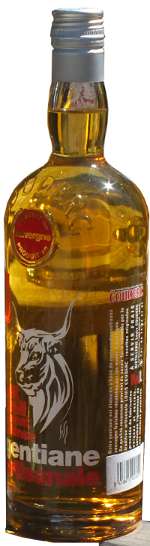
Gentiane
Gentiane is an aperitif or liqueur made from distilling the juices from the roots of the yellow gentian plant. It is a traditional drink of the Auvergne, popularized in the 19th century, and is also made in the Jura and the Alps. The yellow gentian plant normally grows at altitudes above 1000 metres.
Other Auvergne specialities
Les lentilles du
Puy / le Puy lentils
La potée auvergnate / Auvergne hotpot
La potée auvergnate is a classic country dish made up of simple and easily available ingredients; cabbages, potatoes, bacon, pork and sausage. Sometimes white beans are added. After an initial stewing, the cabbages are removed from the pot, then drained and fried up with pieces of bacon. .
Les Tripoux
Auvergne tripe...
Pounti
A delicious type of meat loaf, with herbs, and stuffed with prunes. This speciality of the Cantal can be eaten hot or cold.
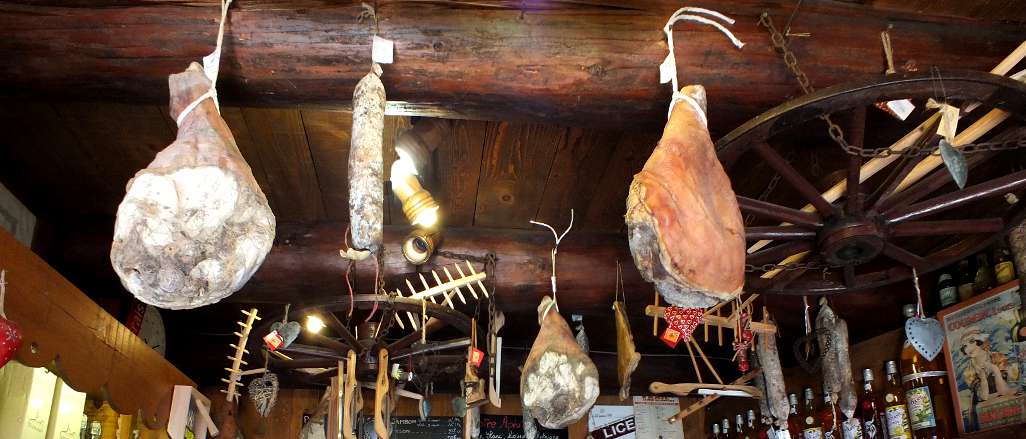
Auvergne ham
Cured raw ham from the mountains of Auvergne. In some rural inns, you can still get ham that has been produced and cured on the spot or in the local village.
Cultivated
for over 2000 years in the region of Le Puy en Velay, the "green
lentils" are still produced using no chemical fertilizers. The
"Appellation contrôlée" production area covers
88 communes in
the Haute Loire department, from Saint Georges
d'Aurac or
Retournac in the north, to Pradelles in the south. Lentils are an
extremely nutritious and tasty vegetable, and a rich source of
vegetable protein.
La potée auvergnate / Auvergne hotpot
La potée auvergnate is a classic country dish made up of simple and easily available ingredients; cabbages, potatoes, bacon, pork and sausage. Sometimes white beans are added. After an initial stewing, the cabbages are removed from the pot, then drained and fried up with pieces of bacon. .
Les Tripoux
Auvergne tripe...
Pounti
A delicious type of meat loaf, with herbs, and stuffed with prunes. This speciality of the Cantal can be eaten hot or cold.
Auvergne ham
Cured raw ham from the mountains of Auvergne. In some rural inns, you can still get ham that has been produced and cured on the spot or in the local village.
and plenty of other good things to eat; simply delicious rural fare......

A Gitelink
guide


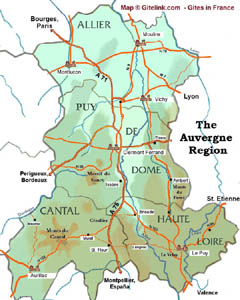
Click map to Enlarge
 Guide Auvergne en
français
Guide Auvergne en
français |
| Useful links |
| Airport - Clermont Ferrand |
| Small campsites in Auvergne |
| Independent hotels in Auvergne |
Restaurants:
Some noteworthy restaurants in the Auvergne region.....
Puy de Dôme
Restaurant La Bicyclette - Cournon d'Auvergne (63)
Restaurant Emmanuel Hodencq Clermont Ferrand (63) Two stars from the Bottin Gourmand.
Hotel / restaurant le Radio à Chamalières (63) Two stars from the Bottin Gourmand.
Hôtel d'Entraigues - Egliseneuve d'Entraigues (63) Classé "Table régionale d'Auvergne"
Allier
Restaurant Jacques Decoret, Vichy (03): Listed among the 100 best restaurants in France by the Guide Fabre. Three stars from the Bottin Gourmand.
Restaurant l'Escargot qui Tete, Vichy (03) - spécialités régionales.
Haute Loire
Restaurant le Haut-Allier, Pont d'Alleyras (43). Two stars from the Bottin Gourmand.
Restaurant François Gagnaire, Le Puy en Velay (43). One Michelin star.
Restaurant Régis Marcon, Saint Bonnet le Froid (43). Three stars from the Bottin Gourmand and the Michelin Guide.
Hotel Moderne, Cayres (43) Regional specialities.
Cantal
Restaurent le Puech, Calvinet. (15) The only restaurant in the Cantal classed in the Michelin guide.
Restaurant le Jarrousset, at Murat (15). Chef Jérome Casenave was formerly at the 3-star Restaurant Paul Bocuse in Lyon.
 Professionels
du tourisme et de la culture en Auvergne
Professionels
du tourisme et de la culture en AuvergnePour proposer votre site ou événement au guide
Auvergne Web Guide, auvergne @ gitelink.com