Undiscovered France
Discovering the best of France away from the crowds
► You
are here:
Gitelink France ›
Hidden FranceHidden
France - off the
beaten track and away from
the crowds
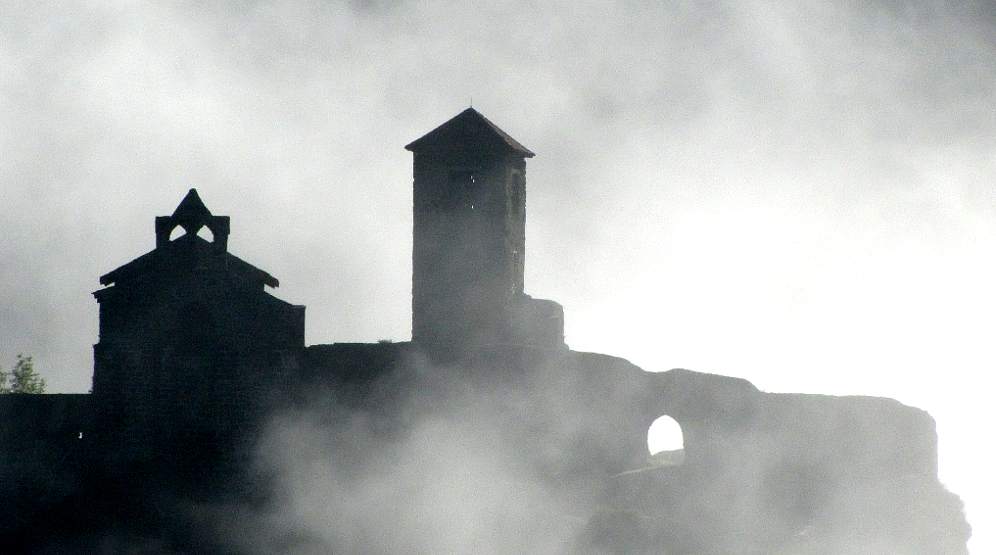
This is
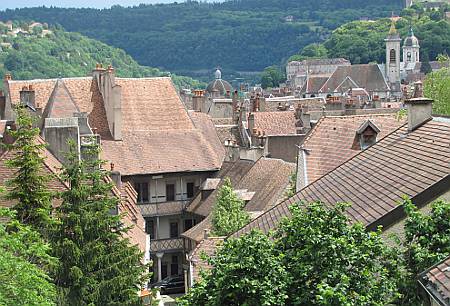
the capital city of a historic French region. It has
some fine museums and a UNESCO world heritage site ... but is
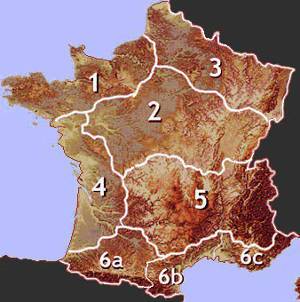
relatively off the beaten track. Where is it? Check out the regions of France
As for the rest of France, get away from the main towns and main motorways, and France is a vast and fairly empty place, with many rural areas where the population today is less than it was a hundred years ago, and the small towns and villages still have a pace of life that is far removed from the hectic frenzy of the cities, the beach resorts, and other main stops on the tourist circuit. But before going into the details, it's not a bad idea to dispel a few myths about rural France, myths propagated daily by the hyperbole and exaggeration of much of the travel press, not to mention travel agents and even local tourist offices. Rural France is not some real-life Disneyland; the "old villages" are not really "undiscovered", few of them are "mediaeval", and throughout France, even in its remotest corners, towns have supermarkets, people drive modern cars, farmers use modern machinery, and the locals have highspeed Internet. Unless (as could perhaps be argued) the Middle Ages lasted in rural France up until the 19th century, the word "mediaeval" is probably the most misused, abused and misleading word in the vocabulary of tourism, when applied to France.
This article is about places that are relatively undiscovered, places in France that don't attract the kind of mass tourism that they would if they were more on the beaten track. And be sure, although it is the world's most popular tourist destination, France is still a country with plenty of places that really are off the tourist trail.
In every region of France, there are areas that are passed by by the crowds. Deepest rural France even stretches into the fringes of the Paris region, notably the south of the region. The Forêt de Fontainebleau is a large forested area, well provided with hiking trails, and dotted with rocky outcrops; in the heart of it lies the village of Barbizon, once the mecca of landscape artists. And in the rural west and the east of the region, dotted with small villages and farming communities, the relative proximity of the Parisian metropolis can seem hard to imagine.
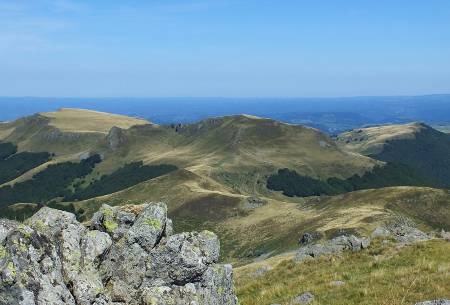
The mountains of the Auvergne - the largest volcanic massif in Europe
Relatively undiscovered regions
While all the regions and areas of France have lots to offer in terms of landscape, heritage, and attractive accommodation, three deserve particular attention: Franche Comté in the east, Auvergne in the centre south, and Midi Pyrenees in the southwest. For a more detailed look at these areas, visit their pages on the Regions of France section of About-France.com.Auvergne.
Classed by Lonely Planet as one of the regions of the world to visit. See Gitelink
Auvergne guide
Franche Comté lies just to the north
of
Switzerland, and comprises most of the French Jura mountains. It is a
beautiful rural area, famed for its cheeses and its clocks: the
regional capital Besançon is a UNESCO world heritage site,
and the
whole area has masses to offer. Auvergne is another mountain
region, and like Franche-Comté it has masses to offer in
terms of
natural heritage and scenery, and even more in terms of historic
monuments and cultural tourism. Lying off the main
traditional
routes to the south of France, it has not developed its huge potential
in terms of outdoor tourism. Midi Pyrenees, stretching from
the
Auvergne to the Spanish border, is larger than Belgium, is very diversified,
but full of history, magnificent landscapes and opportunities to enjoy
a break well away from the crowds.Other regions that can be recommended include Burgundy - rather touristy along the wine trails, but otherwise quite off the beaten track - and Limousin, which is a very rural area of hills and valleys to the west of the Auvergne.
France is divided into departments, the equivalent of counties in the UK. Those in search of peace and quiet in the French countryside may like to check out the best of rural France on About-France.com
 Recommended coastal
areas of France
Recommended coastal
areas of France
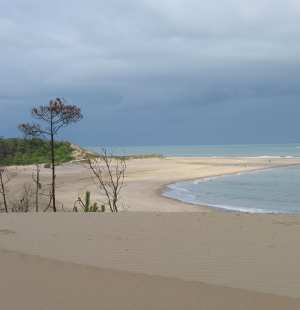
France has a long coastline, and though none of the
French coastline is remotely undiscovered, there are parts that have
room for everyone.
In July and August, beaches are packed in all the popular resorts - but
even at this
time of year there are plenty of places where holidaymakers can
stretch out on the sand in relative seclusion. With its
hundreds
of kilometres of sandy beaches, the Atlantic coast of Aquitaine, once
you get away from the resorts, has
plenty of deserted beaches, .... some
of them best reached on a bicycle.
North of the Gironde there is still
plenty
of room on the beaches, except in the main resorts of which there are
not too many. Even in Brittany and Normandy, while solitude is not so easy
to find, beaches with space on them are not rare - rocky sandy coves on
the north coast, broader sandy beaches on the south. As for
visitors looking for Mediterranean beaches off the beaten track, they
are not completely impossible to find. In Languedoc, the beaches are so
long that there is always plenty of space on them away from the tourist
hubs. The problem may just be finding an undiscovered car park.
More information on the coasts
of France .Driving off the beaten track in France
If time is no object, France offers a first-class network of minor roads. Roads whose numbers are marked as D9** (e.g. D947) are generally former "national" routes, now downgraded because they are essentially regional routes; linking local small towns, these roads are often very well maintained by local authorities, and offer safe easy driving. In many departments, the speed limit on main departmental roads is 90 km/h.... 10 km/h more than on the "N" roads, or routes nationales.. Visitors coming from urban areas will be surprised how little traffic there often is on the byroads of France. Stopping for photos, or to admire the view, is easy - unlike on main roads ; and unlike major routes, the byroads of France actually go through towns and villages, rather than round them, so that visitors actually get to see more of France than the verge of a motorway and an unending series of roadsigns and hoardings .The choice for driving down through France on byroads is enormous: but for those in search of suggestions, here are two sample routes, almost all on small roads, and taking in plenty of interesting towns and countryside. Particularly interesting towns are underlined.
Check out About-France.com for all you need to know about driving in France and also a suggested three to six-day route on Byroads through France, from the Channel coast to the Med.
Two sample
routes through France,
based on byways and minor roads
► Going further? visit undiscovered Spain
► 1. From Cherbourg or Caen:
follow a route via Flers, Mayenne, Laval, La
Flèche, Saumur,
Loches,
Chateauroux, Guéret, Ussel, Aurillac, Rodez,
Albi,
Castres and Carcassonne.
► 2. From Calais: take the A26
motorway as far as Laon then
follow either of these two non-motorway routes:
a) Reims,
Vitry-le-François, Saint Dizier, Chaumont, Langres,
Gray, Besançon,
and Lons-le Saunier, and then by various routes in function
of
your intended destination (Switzerland, the
French Alps, the South),
or...
b) Reims, Epernay, Troyes, Auxerre, Avallon, Autun, Guegnon, Lapalisse, Vichy, Thiers, Ambert, Le Puy en Velay, Aubenas, Alès, Nimes.
b) Reims, Epernay, Troyes, Auxerre, Avallon, Autun, Guegnon, Lapalisse, Vichy, Thiers, Ambert, Le Puy en Velay, Aubenas, Alès, Nimes.
► Going further? visit undiscovered Spain
 Hidden gems
in France
Hidden gems
in France
Several
of the towns underlined on the itineraries above are "hidden gems",
others less hidden. Here is a random selection of other
medium and small
towns in France that are definitely worth making a detour
for:
Dinan
in Brittany, Honfleur
in Normandy, Ornans
in Franche
Comté, Autun
in Burgundy, Cahors
in Midi-Pyrenees, Orthez
in
Aquitaine, Bourges
in the Centre region (get in before 2028... when Bourges will be European capital of culture!) , Brioude
and Le
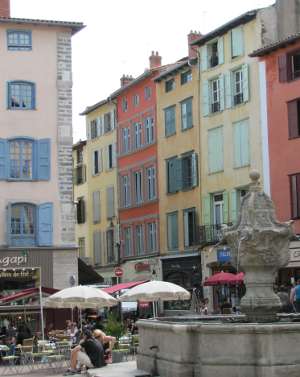
Puy in Auvergne (photo right), or Arles
in Provence.
These
small towns are by no means unknown - they all cater for tourists; but
they are the kind of place, very common in France, that are more
visited by French than by foreign tourists. They are the not-too-hidden
gems of provincial France. As for the really hidden gems, there are hundreds or thousands of these, just waiting to be discovered, and right off the beaten track . But of course, the distinguishing point about hidden gems is that they are not on the normal tourist circuits, but places waiting to be discovered on the off chance by people passing through. To list them would therefore be not only impossible, but also counterproductive. Hidden gems are places discovered through a process of exploration and chance encounters, and by each traveller according to his own choices and priorities. For a good starting point, check out the Regions of France section and the Favourite smaller cities list on About-France.com.
The "most beautiful villages in France".
 The
most beautiful villages in France
The
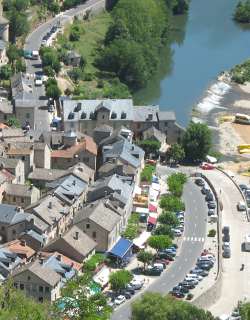
most beautiful villages in France draw in the crowds...
Over and above the officially listed "most beautiful villages in France", there are thousands more very pretty villages in France that have never applied for the label but are inherently just as pretty as many of the officially labelled villages. It's just a matter of setting out on the byroads of France, on your own voyage of discovery, and finding them. Or click for an alternate selection of beautiful villages in France
Accommodation
The small towns of rural France mostly have accommodation in the form of small hotels, generally independent establishments that may have been in the same family for generations. There are also modern hotels - when the town is big enough to justify the need, but even these are often independent or local chains, set up by people with good local knowledge. The big national hotel chains are wary of setting up in this territory, except along main roads and in local capitals. In rural areas, most accommodation is in the form of occasional wayside hotels, or else gites (country cottages) or bed and breakfast. And of course there are plenty of campsites throughout rural France, though not too many of them stay open all year - or at least, not officially.Some
useful sources of accommodation information:
- Small hotels: the Independent hotel guide.
- Gitelink : Gites direct from the owners
- Small rural campsites: Rural Camping France
► Return to Gites in France

Gitelink - a selection of
self-catering holiday cottages for hire directly from the owners.
No
fees !
With Gitelink book
directly with owners, avoiding the commissions and
administrative
fees charged by many online holiday rental agencies and websites.
Some properties may or must be booked through a booking
portal that does not charge any fees to the
customer.
The Gitelink
selectionGites throughout France - clickable map