

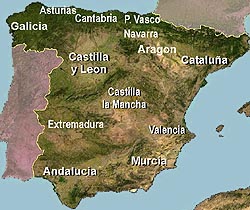
The regions of Spain
|
Gitelink
España
Travel guide
Click below for rural holiday accommodation in the regions of Spain |
| Add your website to Gitelink España:
If you have a site presenting a traditional rural holiday property, send us an email giving details. We will send you further information. Click here to email |
|
Ajouter votre site sur
Gitelink
Espagne: Pour inscrire votre gite ou villa, contactez-nous par email avec les détails. Les informations concernant l'inscription vous seront envoyées par retour. |
Copyright Gitelink.com 2008-2024
Getting to Spain and getting roundSpain is a big country, and distances can be long; driving from Northern Europe to Spain is a time consuming operation, which explains why the majority of British or German tourists visiting Spain prefer to fly and then use some form of local transport - hire car, bus, or train.Flying to SpainSpain is very well served by scheduled flights from Britain and the north of Europe. Consult the websites of the following airlines, among others, for route maps and timetables: Flybe, British Airways,Jet2, Ryanair and Easyjet.There is one major international airport in Spain, and that is Madrid. Madrid has worldwide connections, and connecting flights to domestic airports throughout Spain, including some not served by any international flights. A second and expanding international hub is Barcelona, now served by direct flights from the USA, Canada, Russia, and Asia. In addition there are busy - or not-so-busy - airports all along the Spanish coast, particularly on the Mediterranean. The major airports on the Mediterranean coast are Barcelona, Alicante and Malaga, all of which are served by scheduled flights and charters from a whole range of UK and north European airports. Smaller airports are located on the Mediterranean coast at Girona and Reus - in Catalonia - , at Valencia, Murcia, and Almeria. There are also two inland airports in southern Spain, served by international flights; Sevilla (Seville) and Granada. Naturally, all of the main Spanish islands also have well-served airports; Ibiza, Palma de Mallorca, Tenerife, and others. Along the north coast of Spain, there are airports at Bilbao, Santander, Oviedo, La Coruña, Santiago and Vigo - though these are not served as well as the airports in the south. Spain even has an airport that for a long time had no flights ! Castellon airport on the Costa Ahazar stood idle for years, and still has no daily services - just a few sporadic flights with Ryanair Driving in SpainFor lots of information on driving, see driving in Spain on About-Spain.netPublic transport in SpainSpain has Europe's most extensive network of high-speed railways. AVE lines link Madrid with Seville, via Cordoba, and with Saragossa and Barcelona and Paris in the north east.Where there is no AVE service, the train in Spain is a relatively slow-moving beast, and many Spaniards will prefer to use the country's good network of long-distance bus services. These services - by air-conditioned coach - link most big towns and cities, and offer fast and comfortable transport, which is above all cheap and good value for money. Gitelink Spain - home Gitelink France |
| For bookings and information please contact directly the owners of the property concerned : do not contact Gitelink Espana! | Pour réservations ou renseignements, adressez-vous directement aux propriétaires des gîtes, et non à Gitelink España s.v.p! |